
Artificial intelligence is changing how people work, learn, create content, and solve everyday problems. From chatbots and image generators to voice recognition and automated research, AI-powered technology is becoming part of almost every industry. However, finding the right tools and resources to experiment with artificial intelligence can be challenging. This is where Hugging Face becomes particularly useful.
Hugging Face is a popular platform that brings together AI developers, researchers, businesses, and technology enthusiasts. It provides access to machine learning models, datasets, interactive applications, and development tools. Whether you are a beginner exploring artificial intelligence or an experienced developer building an advanced application, the platform offers resources that can help turn ideas into practical solutions.
What Is Hugging Face?
Hugging Face is an online platform and technology company focused on making machine learning more accessible through open collaboration.
It is widely recognized for its community-driven approach to artificial intelligence. Users can discover pretrained models, upload datasets, share projects, experiment with applications, and collaborate with other developers.
One of its biggest attractions is the Hugging Face Hub, which acts as a central library for machine learning resources.
Instead of building every AI component from scratch, developers can explore existing models and adapt suitable ones to their requirements. This can reduce development time and make experimentation more accessible.
The platform supports different AI applications, including:
-
Natural language processing and text generation.
-
Image classification and image generation.
-
Speech recognition and audio processing.
-
Video-related machine learning.
-
Translation and summarization.
-
Computer vision and robotics.
How Does the Platform Work?
The platform operates through a collection of interconnected tools and community resources. Users can browse available projects, examine their documentation, test supported applications, and download resources when permitted by their licenses.
Three major sections make the experience particularly useful.
1. AI Models
Models are among the most important resources available on the platform. A machine learning model is trained to recognize patterns and perform specific tasks.
For example, a language model can generate text, answer questions, or summarize documents. An image model might identify objects, recognize faces, or generate pictures from written instructions.
Developers can explore models from different contributors, compare their capabilities, and select an appropriate option for their projects.
2. Datasets
Datasets contain information used to train, evaluate, or test machine learning systems.
Hugging Face provides datasets covering different subjects and formats, including text, images, audio, and structured information.
Researchers can use these resources to experiment with algorithms, evaluate model performance, and understand how different training materials influence results.
However, users should always review dataset documentation, licensing conditions, and potential privacy concerns before using data in commercial or public projects.
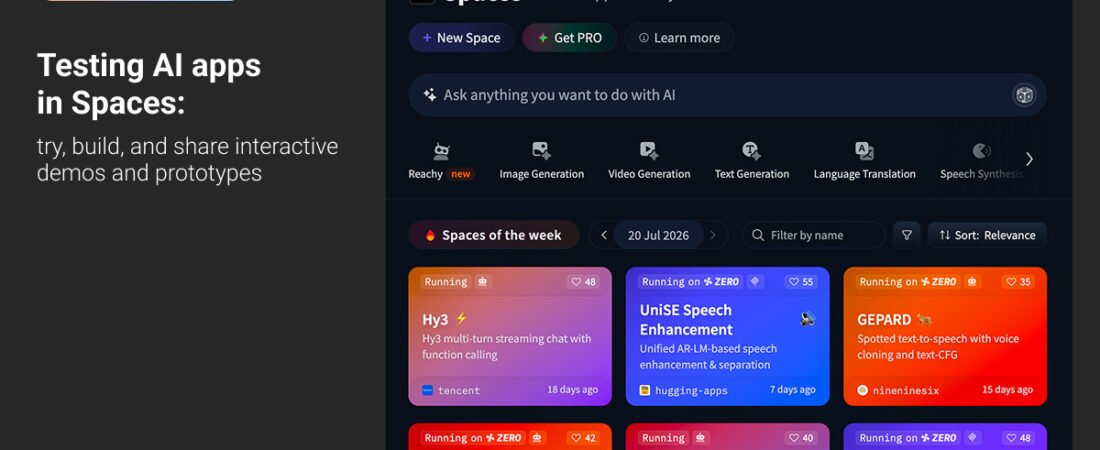
3. Spaces
Spaces allow users to create and share interactive machine learning applications.
These applications can provide simple interfaces for testing AI models without requiring visitors to write complicated code.
For example, someone might publish an application that converts speech into text, generates images, translates sentences, or answers questions.
This makes the technology easier to explore, even for people who are not professional programmers.
Popular Hugging Face Tools and Libraries
Beyond its online model collection, the ecosystem includes several development libraries.
Transformers: This library provides access to pretrained models for natural language processing, computer vision, audio, and other machine learning tasks.
Diffusers: Developers use this library to work with diffusion models, including systems designed for image and other media generation.
Datasets: This tool helps developers load, process, and share datasets for machine learning experiments.
Tokenizers: It provides efficient methods for converting text into smaller units that language models can process.
PEFT: Parameter-Efficient Fine-Tuning provides techniques for adapting large pretrained models while updating fewer parameters.
These resources help developers move from experimentation toward building practical AI applications.
Why Are Developers and Businesses Using It?
The growing interest in this ecosystem comes from its flexibility and collaborative environment.
Here are some important advantages.
Access to Pretrained Models
Training a machine learning model from the beginning can require substantial computing resources, technical knowledge, and time.
Pretrained models provide a starting point. Developers can evaluate existing options and adapt them for particular tasks when the model’s license and technical requirements allow it.
Open Collaboration
The platform encourages people to share their work and learn from other contributors.
Developers can publish projects, improve existing resources, discuss technical challenges, and contribute to the wider machine learning community.
Beginner-Friendly Exploration
Not everyone needs advanced programming knowledge to start exploring AI.
Interactive Spaces provide an opportunity to test different applications and understand what machine learning can accomplish.
Flexible Development Options
From small experiments to larger applications, developers can select resources according to their technical requirements.
The availability of different models and libraries also makes it easier to compare approaches instead of relying on a single solution.
Hugging Face vs. Other AI Development Platforms
Different AI platforms serve different purposes. Understanding their strengths can help users choose the right environment.
| Platform | Main Purpose | Best For |
|---|---|---|
| Hugging Face | Models, datasets, and AI applications | AI experimentation and collaboration |
| Google Colab | Cloud-based coding notebooks | Running machine learning experiments |
| Kaggle | Datasets and competitions | Data science practice |
| OpenAI API | Accessing AI models through APIs | Integrating AI into applications |
These platforms are not necessarily direct competitors in every situation. Developers frequently combine multiple services to complete a project.
For example, someone might discover a model on Hugging Face, prepare their dataset using Python, experiment in Google Colab, and eventually integrate the finished solution into a website.
Practical Applications of Hugging Face in Business
Imagine a small online store receiving hundreds of customer messages every week.
The business owner wants to reduce repetitive work without hiring additional support staff immediately.
A developer could explore language models through the platform and identify one suitable for understanding customer questions. They might then prepare a collection of common support questions and answers, test the model, and develop an interactive application.
The resulting tool could help customers find information about delivery policies, product specifications, and return procedures.
However, sensitive customer information should be protected, and important decisions should remain subject to human review.
This example demonstrates how shared AI resources can help businesses experiment with useful solutions without developing every component independently.
Is Hugging Face Free to Use?
Many resources are available without payment, particularly publicly accessible models, datasets, documentation, and community projects.
However, not every service is free.
Certain features, including additional computing resources, managed inference services, and enterprise solutions, may involve charges.
Pricing can depend on the selected service, hardware, usage, and account requirements. Some models may also have separate licensing restrictions.
Before starting a project, review the relevant pricing information and model documentation.
How to Get Started
Getting started does not require building an advanced machine learning system.
Follow these simple steps:
-
Visit the official Hugging Face website.
-
Create an account if you want to save projects or participate in the community.
-
Explore the Models section to discover available AI systems.
-
Browse Datasets to find suitable training or testing resources.
-
Visit Spaces to experiment with interactive applications.
-
Read the documentation before integrating a model into your own project.
My recommendation is to begin with an existing interactive application rather than immediately attempting to train a large model. This provides a practical understanding of what the technology can do before you invest time in development.
Important Things to Consider Before Using AI Models
Although the platform offers many useful resources, choosing a model requires careful evaluation.
Check its license, documentation, training information, hardware requirements, and intended use. A model that performs well in a demonstration might not deliver equally reliable results in a real business environment.
Also consider accuracy, response speed, data security, and ongoing maintenance.
Another important point is that publicly accessible does not automatically mean unrestricted commercial use. Always read the individual license terms.
Also Read: Hiring Near Me: Find Local Jobs & Apply Today
Conclusion
Hugging Face has become an important destination for people interested in artificial intelligence and machine learning. Its combination of pretrained models, datasets, interactive Spaces, and development libraries makes it easier to discover, experiment with, and build AI-powered solutions.
Beginners can explore practical applications, while experienced developers can use its resources to accelerate research and application development.
Whether your goal is to understand machine learning, develop a chatbot, experiment with image generation, or create a business application, this ecosystem provides a valuable starting point. The best approach is to explore gradually, compare available resources, and choose tools that genuinely match your objectives.
FAQs
1. What is Hugging Face mainly used for?
It is used to discover, share, test, and develop machine learning models, datasets, and AI applications. Developers and researchers use it for natural language processing, computer vision, audio processing, and other AI projects.
2. Is Hugging Face suitable for beginners?
Yes. Beginners can explore interactive Spaces, read tutorials, and experiment with pretrained models. Advanced programming knowledge is not necessary for every activity.
3. Can I use Hugging Face models for free?
Many models and resources are publicly accessible without payment. However, certain computing services and advanced features may require payment. Individual model licenses can also impose usage restrictions.
4. What is the Hugging Face Hub?
The Hugging Face Hub is an online repository where users can discover and share machine learning models, datasets, and interactive applications.
5. What are Hugging Face Spaces?
Spaces are interactive applications hosted on the platform. They allow users to demonstrate and experiment with AI projects through accessible interfaces.
6. Can businesses use Hugging Face?
Yes. Businesses can explore models, develop AI applications, experiment with automation, and build customized machine learning solutions. They should evaluate licensing, security, infrastructure, and commercial usage requirements before deployment.