
Paying for college can be a major financial challenge, especially when tuition, housing, books, and other education expenses exceed the financial aid a student receives. For families in the United States, a Parent PLUS loan is one federal financing option that allows eligible parents to help cover the cost of an undergraduate education.
However, borrowing money for a child’s education is a long-term financial commitment. Understanding the eligibility requirements, interest rates, borrowing limits, repayment rules, and available alternatives can help families make a more informed decision.
Whether you’re considering applying for the first time or reviewing an existing balance, here’s what you need to know before moving forward.
What Is a Parent PLUS Loan?
A Parent PLUS loan is a federal Direct PLUS Loan made to an eligible parent of a dependent undergraduate student. The money helps cover qualified education expenses that aren’t fully covered by other financial aid.
Unlike federal student loans borrowed by the student, this debt belongs to the parent. The parent is legally responsible for repaying the loan, even after the child graduates or begins earning an income. The debt cannot simply be transferred to the student.
Parents can use approved loan funds toward expenses included in the school’s cost of attendance, such as tuition, required fees, housing, meals, and other eligible education costs.
Before borrowing, families should compare the remaining funding gap with the total amount they would repay over time.
Who Qualifies for a Parent PLUS Loan?
Eligibility depends on the parent’s relationship to the student, the student’s enrollment, credit history, and general federal student aid requirements.
Generally, an applicant must:
-
Be the biological or adoptive parent of a dependent undergraduate student, or an eligible stepparent.
-
Have a child enrolled at least half-time at an eligible institution.
-
Meet the applicable federal student aid eligibility requirements.
-
Pass the credit-history requirements or satisfy the additional conditions for approval when an adverse credit history exists.
Grandparents and legal guardians generally cannot borrow through this program unless they have legally adopted the student.
An adverse credit history does not always mean approval is impossible. Eligible applicants may be able to use an endorser or document qualifying extenuating circumstances, subject to federal requirements and any required credit counseling.
Families should complete the Free Application for Federal Student Aid (FAFSA) before beginning the parent loan application process. The school’s financial aid office can explain institution-specific procedures.
Student Aid+1
Parent PLUS Loan Interest Rate and Fees
Interest is a significant part of the borrowing decision because it increases the overall cost of financing college.
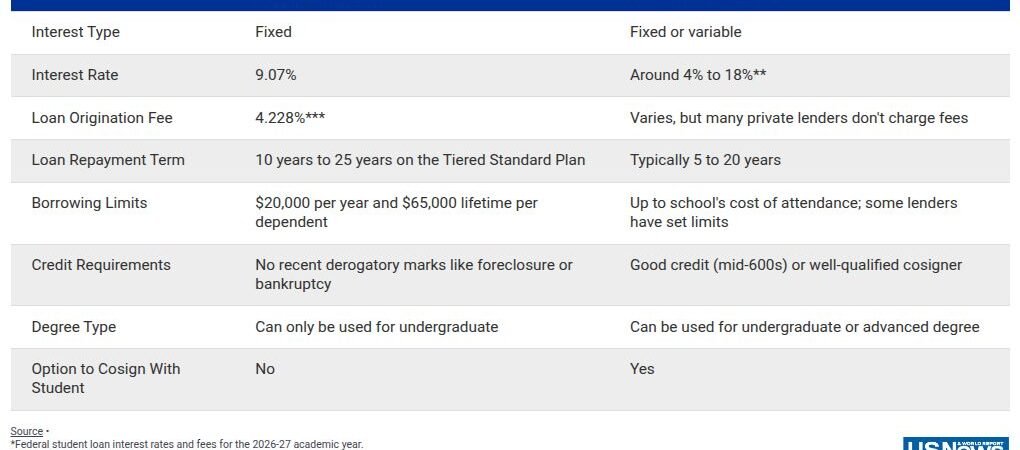
For loans first disbursed from July 1, 2026, through June 30, 2027, the Parent PLUS fixed interest rate is 9.07%. The rate remains fixed for the life of a loan with that rate. A loan fee of 4.228% also applies to these loans under the published federal fee schedule.
The fee is deducted proportionately from loan disbursements, meaning the amount credited toward college expenses may be lower than the amount borrowed.
For example, a parent who borrows $10,000 would generally have approximately $9,577.20 disbursed after a 4.228% fee, before accounting for any other adjustments. The parent would still owe the full $10,000 principal, plus applicable interest.
This difference is important when calculating how much to borrow. Requesting extra funds to cover a fee can increase the debt and future payments.
Rates and fees can change for new loans, so verify the terms for your specific disbursement year through Federal Student Aid.
Student Aid+1
How Much Can You Borrow?
Parent PLUS borrowing limits changed on July 1, 2026. The amount available now depends partly on whether the student qualifies for a limited exception to the new rules.
| Borrowing situation | Federal limit |
|---|---|
| Parent not eligible for the limited exception | Up to $20,000 annually per dependent student |
| Parent not eligible for the limited exception | $65,000 total per dependent student |
| Parent eligible for the limited exception | Generally, the remaining cost of attendance after other financial assistance |
The limited exception may apply when the student was enrolled in the same program at the same institution as of June 30, 2026, had the required qualifying federal loan disbursement before July 1, 2026, and remained continuously enrolled in that program at that institution.
Additional conditions apply, and the school may limit borrowing based on the student’s program. The financial aid office can confirm whether the exception applies to your family.
Student Aid+1
These limits make it especially important to calculate the full cost of a degree before relying on parent borrowing for multiple academic years.
How Does Repayment Work?
Repayment usually begins after the loan is fully disbursed unless the parent requests and receives an eligible deferment. Parents can request to postpone payments while their child is enrolled at least half-time and for an additional six months after the student graduates, leaves school, or drops below half-time enrollment.
But postponing payments does not mean the debt stops growing. Interest continues to accumulate during deferment, potentially increasing the balance when repayment resumes.
For loans first disbursed before July 1, 2026, eligible borrowers may have access to Standard, Graduated, or Extended repayment, depending on their circumstances. Certain borrowers who completed the required consolidation steps before the deadline may also have access to the Income-Contingent Repayment plan under transitional rules.
For new Parent PLUS loans disbursed on or after July 1, 2026, the repayment options have changed. These loans generally fall under the new Tiered Standard Repayment Plan, and income-driven repayment options are restricted. Borrowers should confirm their eligibility and terms directly with their loan servicer.
Student Aid+2
Is a Parent PLUS Loan Worth It?
The answer depends on your household budget, the amount you need, and the alternatives available. Federal parent borrowing can help close a college funding gap, but its relatively high interest rate and the parent’s legal responsibility deserve careful consideration.
Before applying, compare these options:
-
Federal student loans: Eligible students may qualify for federal loans with lower borrowing costs or more favorable terms than parent borrowing.
-
Scholarships and grants: These may reduce college costs without requiring repayment.
-
College payment plans: Some institutions allow families to spread tuition payments across several installments.
-
Private education loans: Compare interest rates, fees, repayment terms, credit requirements, and protections before deciding.
I would always calculate the expected monthly payment and total repayment cost before committing to education debt, rather than judging affordability by the amount the lender allows you to borrow.
A Practical Example: Planning for College Costs
Imagine a family whose child has $15,000 in education expenses remaining after scholarships and other financial aid. The parent is considering borrowing the full amount through a federal parent loan.
Instead of applying immediately, the family reviews its monthly budget, asks the college about installment payments, and checks whether additional grants are available. They discover that a payment plan and additional savings can cover part of the gap, reducing the amount they need to borrow.
This approach can help limit interest costs and leave the parent with more room in the household budget for retirement savings, emergency expenses, and other obligations.
The lesson is simple: borrow for the remaining financial need, not merely because additional borrowing appears available.
How to Apply for a Parent PLUS Loan
If you decide this option fits your situation, follow these steps:
-
Complete the FAFSA: Make sure your child has submitted the required federal student aid application.
-
Review the financial aid offer: Ask the college how much remains unpaid after grants, scholarships, and student aid.
-
Check eligibility and limits: Confirm your credit eligibility and which borrowing rules apply to your child’s enrollment.
-
Submit the application: Use the official Federal Student Aid website or follow your college’s application instructions.
-
Review the loan agreement: Understand the interest rate, fees, repayment terms, and Master Promissory Note before accepting the obligation.
-
Monitor the loan: Keep track of disbursements, interest, payment dates, and communications from your loan servicer.
Taking time to review each step can help prevent borrowing more than your family needs.
Student Aid+1
Conclusion
A Parent PLUS loan can help eligible families finance undergraduate education when other forms of aid do not cover the full cost. However, the parent—not the student—is responsible for repayment, and interest and fees can make borrowing expensive.
Before applying, compare federal student aid, scholarships, college payment plans, and other financing options. Pay particular attention to the new borrowing limits and repayment rules introduced in July 2026. The right decision is one that supports your child’s education without placing your long-term financial stability at unnecessary risk.
FAQs
1. Can a student repay a Parent PLUS loan instead of the parent?
A student can voluntarily help make payments, but the parent remains legally responsible for the debt. The loan cannot be transferred to the child through the federal program.
2. Does a Parent PLUS loan require a credit check?
Yes. Applicants must meet federal credit-history requirements. An applicant with an adverse credit history may qualify through an eligible endorser or an approved explanation of extenuating circumstances.
3. Can Parent PLUS loan payments be postponed?
Eligible parents can request deferment while their child attends school at least half-time and for six months after qualifying enrollment ends. Interest generally continues accruing during the deferment.
4. What is the Parent PLUS loan limit in 2026?
For academic years beginning on or after July 1, 2026, the general limit is $20,000 per dependent student per year and $65,000 in total per student. Certain qualifying families may be covered by a limited exception to these caps.
5. Is a Parent PLUS loan eligible for forgiveness?
Some borrowers may qualify for Public Service Loan Forgiveness if they meet all applicable employment, repayment, and loan requirements. Eligibility depends on the loan’s history and the rules in effect; borrowers should verify their specific circumstances before relying on forgiveness.