Student debt can follow you long after graduation. Monthly payments compete with rent, groceries, savings, and other financial responsibilities, making it difficult to plan for the future. Fortunately, student loan forgiveness programs may help eligible borrowers reduce or eliminate their remaining federal education debt.
However, not everyone qualifies, and the rules depend on your loan type, employment, repayment history, and individual circumstances. Understanding these requirements can save you time, prevent costly mistakes, and help you identify legitimate opportunities for debt relief.
Whether you’re a teacher, a healthcare professional, a government employee, or a graduate struggling with repayments, here’s how student debt cancellation works and what steps you can take to explore your options.
What Is Student Loan Forgiveness?
Student loan forgiveness is a program that cancels some or all of an eligible borrower’s remaining education debt after specific requirements are met. Depending on the program, qualification may depend on your career, income, repayment history, disability status, or circumstances involving your school.
Most federal forgiveness options apply to loans issued or managed under qualifying U.S. federal student aid programs. Private student loans generally do not qualify for federal forgiveness programs, although some private lenders offer hardship assistance or other relief.
It’s also important to understand the difference between forgiveness and discharge. Forgiveness commonly refers to debt cancellation earned through qualifying employment or repayment. Discharge can apply in situations such as permanent disability or certain school-related circumstances.
Neither option is automatic for every borrower.
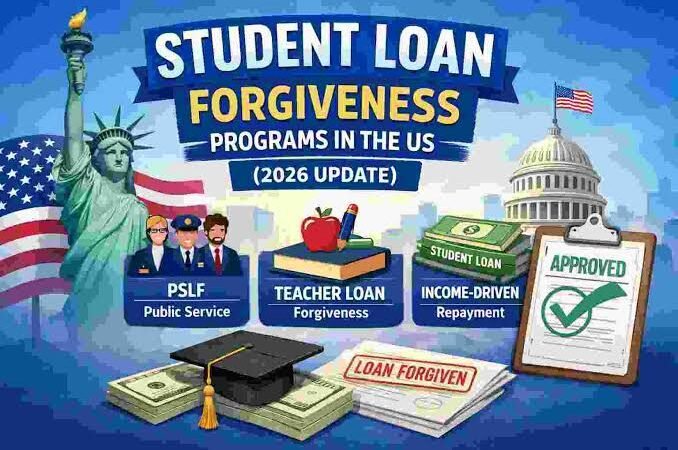
Major Student Debt Forgiveness Programs
Several federal programs serve different groups of borrowers. The right option depends on your circumstances rather than simply how much you owe.
1. Public Service Loan Forgiveness (PSLF)
Public Service Loan Forgiveness is designed for people working in qualifying public service positions. Eligible employers include government organizations and certain nonprofit organizations.
To qualify, borrowers generally need eligible Direct Loans, qualifying employment, and 120 qualifying monthly payments under the applicable repayment requirements. These payments do not necessarily need to be consecutive.
For example, a nurse employed full-time by an eligible nonprofit hospital may qualify even if they change jobs during their repayment journey, provided their employment and payments meet the program’s rules. Working in healthcare alone, however, does not guarantee eligibility.
Borrowers should use the official PSLF Help Tool to check their circumstances and certify eligible employment.
2. Income-Driven Repayment Forgiveness
Income-driven repayment (IDR) plans calculate monthly payments using factors such as income, family size, and the rules of the particular plan. Depending on the plan and applicable law, a remaining balance may be discharged after a qualifying repayment period.
The timeline and eligibility requirements can vary. Changes to federal student aid legislation and repayment programs also mean borrowers should verify which plans are currently available to them.
For borrowers whose payments are difficult to manage, an eligible income-based plan may provide a more sustainable repayment arrangement while they work toward potential future relief.
Explore current options through the official Federal Student Aid website .
3. Teacher Loan Forgiveness
Eligible teachers may receive up to $17,500 in federal loan forgiveness after teaching full-time for five complete and consecutive academic years in qualifying low-income schools or educational service agencies.
The amount depends on the subject taught and other eligibility requirements. Not every teacher receives the maximum benefit.
Teachers should compare this program with Public Service Loan Forgiveness before applying. The same period of teaching service cannot be used to receive both benefits, so choosing the right route can make a meaningful financial difference.
4. Disability and School-Related Discharge
Borrowers with a qualifying total and permanent disability may be eligible to have certain federal student loans discharged.
School-related relief may also be available in specific circumstances. For instance, borrowers whose schools close while they are enrolled or soon after withdrawal may qualify for a closed-school discharge. Borrower defense may apply when qualifying misconduct by a school provides a legal basis for relief.
These options have separate eligibility standards and documentation requirements. Review the official rules before assuming your situation qualifies.
Comparing Student Loan Forgiveness Options
Choosing a program becomes easier when you compare the main eligibility requirements, timelines, and benefits.
|
Program |
Who may qualify? |
Potential benefit |
|---|---|---|
|
Public Service Loan Forgiveness |
Eligible government and nonprofit employees |
Remaining qualifying Direct Loan balance after 120 qualifying payments |
|
Income-driven repayment forgiveness |
Borrowers meeting an eligible plan’s requirements |
Remaining balance after the applicable repayment period |
|
Teacher Loan Forgiveness |
Eligible teachers in qualifying low-income schools |
Up to $17,500 |
|
Total and Permanent Disability discharge |
Borrowers meeting disability requirements |
Discharge of eligible federal education debt |
|
School-related discharge |
Borrowers meeting specific school-related criteria |
Partial or full discharge, depending on the program |
Benefits are subject to current federal rules, loan eligibility, and individual circumstances. Review the official federal forgiveness and discharge guidance before making decisions.
How to Apply for Student Loan Forgiveness
Finding a program is only the beginning. Accurate records and careful planning can help you avoid delays.
-
Identify your loan type. Sign in to StudentAid.gov to review your federal loans, balances, and servicer information. Private loans generally require separate discussions with your lender.
-
Check your eligibility. Review the program’s employment, repayment, and loan requirements. Don’t assume that having a low income or working in public service automatically qualifies you.
-
Review your payment history. If you’re pursuing a repayment-based program, confirm which payments count and how many qualifying payments remain.
-
Submit the appropriate application. Use official government tools and follow the instructions for your specific program. Some borrowers must also document their employment or provide supporting records.
-
Monitor your account. Save application confirmations, payment statements, and correspondence. Follow up if your payment count or eligibility status appears incorrect.
One practical lesson I would emphasize is simple: verify your eligibility before making a major repayment decision. Consolidating loans, switching plans, or changing employment arrangements can affect your options, depending on the rules that apply.
-
How the Right Career Choice Can Help Reduce Student Debt
Imagine a recent graduate named Sarah who owes $48,000 in eligible federal student loans. She accepts a full-time position with a qualifying nonprofit organization and plans to remain in public service.
Rather than choosing a repayment plan at random, Sarah checks her loan types, confirms her employer’s eligibility, and reviews her payment options. She then tracks qualifying payments and keeps records of her employment.
If she meets all applicable requirements for Public Service Loan Forgiveness, she may qualify to have her remaining eligible balance forgiven after 120 qualifying payments.
Her outcome isn’t guaranteed simply because she works for a nonprofit. The lesson is that understanding the rules early can help borrowers make informed decisions throughout repayment.
Avoid Student Loan Forgiveness Scams
Debt relief can attract misleading promises. Be cautious of companies that guarantee immediate cancellation, pressure you to act quickly, or demand fees to access government forgiveness programs.
You can apply for federal student aid benefits through official channels without paying a company to secure forgiveness on your behalf. Never share your StudentAid.gov password or sensitive account information with an unverified service.
For trustworthy information, start with Federal Student Aid or the Consumer Financial Protection Bureau .
Conclusion
Student loan forgiveness can provide meaningful financial relief, but finding the right program requires more than checking your outstanding balance. Your loan type, career, payment history, and eligibility for specific federal benefits all matter.
Start by reviewing your loans, comparing available programs, and confirming the latest requirements through official government resources. Keep your records organized, avoid companies promising guaranteed cancellation, and consider the long-term consequences before changing repayment plans.
With accurate information and a clear repayment strategy, you can make better decisions about managing education debt and working toward greater financial stability.
FAQs
1. Who qualifies for student loan forgiveness?
Eligibility depends on the program. Government and certain nonprofit employees may qualify for PSLF, eligible teachers may qualify for teacher forgiveness, and some borrowers may qualify through income-driven repayment, disability, or school-related discharge programs.
2. Can private student loans be forgiven?
Private student loans generally aren’t eligible for federal forgiveness programs. However, some lenders may offer hardship assistance, modified repayment arrangements, or settlement options. Contact your lender to understand the available choices.
3. How long does student loan forgiveness take?
The timeline varies. PSLF generally requires 120 qualifying monthly payments, while income-driven repayment forgiveness depends on the applicable plan and repayment period. Other discharge programs follow different requirements.
4. Is student loan forgiveness automatic?
Not always. Some eligible discharges may be processed automatically, but many programs require borrowers to submit applications, verify employment, or provide documentation. Check your account and follow the official application instructions.
5. Does student loan forgiveness affect your taxes?
It can. Federal tax treatment depends on the type of forgiveness and the applicable law when the debt is discharged. State tax rules may differ. For discharges occurring in 2026 or later, check current federal guidance and consult a qualified tax professional about your situation.
6. Where can I check my student loan forgiveness eligibility?
Visit StudentAid.gov to review your federal loans and explore available programs. For PSLF, use the official PSLF Help Tool .