
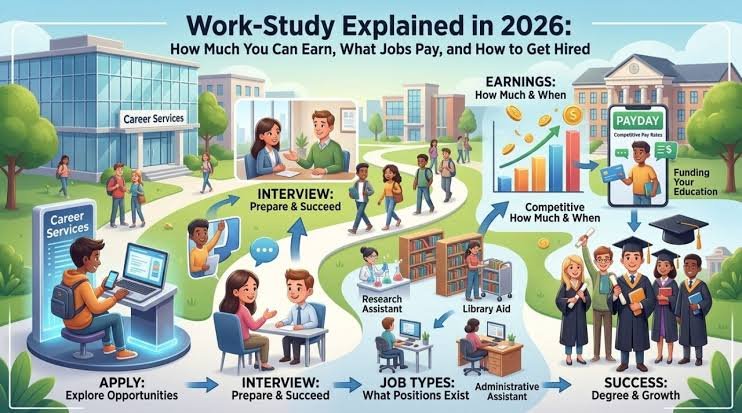
Choosing how to pay for college can be challenging, especially when tuition, textbooks, transportation, and everyday expenses keep adding up. For students who want to earn money while continuing their education, work study can offer a practical way to balance employment with academic responsibilities.
A work-study opportunity allows eligible students to work while attending school, often through a college or university. In the United States, the term commonly refers to the Federal Work-Study Program, which provides funding to participating educational institutions to help create part-time employment opportunities for students with financial need.
However, there is an important detail to understand: work study is not a scholarship, and it does not automatically reduce your tuition bill. Students generally earn wages by working, then use that income to cover expenses. Understanding how the program works can help you decide whether it fits your financial situation, academic schedule, and future career goals.
What Is Work Study?
Work study is a student employment arrangement designed to help eligible students earn money while pursuing their education. Jobs may be available on campus, in administrative offices, libraries, research departments, or certain community organizations.
The Federal Work-Study Program is administered by participating colleges and universities under federal guidelines. Eligibility is generally determined through the financial aid process, and students must meet the institution’s requirements to receive an award and secure a position.
Typical jobs may include:
-
Library assistant
-
Office or administrative assistant
-
Research assistant
-
Campus information desk worker
-
Tutoring assistant
-
Community service worker
These positions can provide more than a paycheck. They may also help students develop communication, organization, teamwork, and professional skills before graduation.
How Does Work Study Work?
The process usually begins when a student applies for financial aid. In the United States, students generally complete the Free Application for Federal Student Aid (FAFSA) to be considered for federal student aid, including Federal Work-Study eligibility.
Receiving a work-study award does not necessarily mean you already have a job. You may need to search for an approved position, submit an application, interview, and complete the school’s hiring process.
Once hired, you work scheduled hours and receive wages according to the applicable pay arrangements. Earnings depend on the hourly rate, hours worked, and the amount authorized under your award.
Here is the process in simple terms:
-
Complete the FAFSA and any additional financial aid requirements.
-
Check whether your financial aid offer includes work-study funding.
-
Explore eligible jobs through your college’s student employment office.
-
Apply for a suitable position and complete the hiring process.
-
Work your scheduled hours and receive your wages.
-
Monitor your earnings, work hours, and academic workload.
One useful distinction is that a work-study award represents an opportunity to earn money, not a guaranteed lump-sum payment. If you do not find a position or do not work enough hours, you may not earn the full amount listed in your award.
Who Is Eligible for Work Study?
Eligibility depends on the program, institution, and individual circumstances. For Federal Work-Study, students generally need to demonstrate financial need, meet applicable federal student aid eligibility requirements, and attend a participating institution.
Your school also considers its available funding and employment opportunities. As a result, two students with similar financial circumstances may receive different work-study offers.
Students should check their financial aid packages carefully and contact the financial aid office if the award is missing or unclear. International students and students studying outside the United States should not assume that federal work-study rules apply to them; their available employment options depend on local laws, visa conditions, and institutional policies.
Benefits of Work Study for College Students
A student job can serve several purposes at once. Beyond providing income, it can introduce you to a professional environment and help you build habits that remain useful after graduation.
1. Earn Money While Studying
Students can use their wages to cover groceries, transportation, books, internet access, and other everyday costs. Because employment is generally part-time, it may be easier to fit around classes than a demanding full-time job.
Still, earnings vary. Calculate your expected take-home pay before relying on it for essential bills.
2. Gain Relevant Work Experience
A campus job can help you develop practical skills before entering the job market. For example, an administrative role may strengthen your communication and organizational abilities, while a research assistant position may provide experience related to your degree.
Federal guidelines encourage institutions to offer positions that complement students’ academic programs or career goals where practicable.
2026-2027 Federal Student Aid Handbook+1
3. Build Professional Connections
Working alongside faculty, staff, researchers, or community organizations can introduce you to people who may offer career advice, references, or information about future opportunities.
4. Reduce Dependence on Borrowing
Unlike a student loan, work-study wages do not have to be repaid. Although earnings may not cover every educational expense, they can help reduce the amount you need to borrow or the pressure on your household budget.
Federal Student Aid+1
Work Study vs. Other Student Financial Aid
Work-study, grants, scholarships, and student loans can all help students manage education costs, but they operate differently. Understanding these differences makes it easier to build a realistic funding plan.
| Feature | Work study | Grants and scholarships | Student loans |
|---|---|---|---|
| How you receive money | Earn wages through employment | Receive an award subject to its terms | Borrow funds |
| Repayment required | No | Usually no, subject to conditions | Generally yes |
| Work required | Yes | No employment requirement in most cases | No employment requirement |
| Income depends on hours worked | Yes | Usually no | No |
| Main consideration | Job availability and schedule | Eligibility and award conditions | Interest and repayment obligations |
Work study is especially useful for students who want to earn income while developing professional skills. Grants and scholarships may be more helpful for expenses that must be paid before a student has time to work. Loans can cover eligible costs but create future repayment obligations.
A balanced financial plan may combine different types of assistance rather than relying on one source alone.
How Much Money Can You Earn Through Work Study?
There is no single amount that applies to every student. Earnings depend on the award, hourly wage, available shifts, and the number of hours you are authorized to work. Your institution also considers financial need and the effect employment may have on academic progress.
2026-2027 Federal Student Aid Handbook+1
For example, suppose you earn $15 per hour and work 10 hours each week for 15 weeks.
-
Hourly wage: $15
-
Weekly hours: 10
-
Working period: 15 weeks
-
Estimated gross earnings: $2,250
This is an illustrative calculation, not a guaranteed work-study award. Taxes, job availability, changes in hours, and your school’s rules can affect your actual earnings.
One practical budgeting tip is to divide expected earnings into essential expenses before spending anything on nonessential purchases. Even a modest paycheck can go further when you assign it a clear purpose.
A Real-World Example: Balancing Work and College
Imagine a student named Sarah who attends college full-time and receives a work-study award. Her textbooks, transportation, and food expenses leave little room in her monthly budget.
She applies for a library assistant position that offers shifts between classes. Sarah works 10 hours per week, uses part of her earnings for transportation and supplies, and saves a smaller amount for unexpected expenses.
During exam weeks, she discusses her schedule with her supervisor in advance and plans her study sessions around her shifts.
Sarah’s situation illustrates an important point: the value of student employment is not measured only by the paycheck. A suitable job, a manageable schedule, and a basic spending plan can make the experience more sustainable.
From a practical planning perspective, I would prioritize a job with predictable hours and a reasonable commute over a position that pays slightly more but regularly interferes with studying.
How to Find and Apply for Work-Study Jobs
Finding a suitable position takes preparation, particularly because funding and vacancies are limited at some colleges. Federal Student Aid recommends checking with your school’s financial aid office and student employment center for information about available positions.
Federal Student Aid
Follow these steps to improve your chances:
-
Complete your FAFSA early. This is the starting point for consideration for Federal Work-Study.
-
Review your financial aid offer. Confirm whether work-study funding has been included.
-
Search your college’s job listings. Look for positions that match your schedule, interests, and skills.
-
Prepare a simple résumé. Include relevant coursework, volunteer activities, technical skills, and previous employment.
-
Apply promptly. Available positions may be limited, even when you qualify for funding.
-
Ask about the working conditions. Confirm the hourly rate, expected shifts, payment schedule, and maximum authorized earnings.
If your award does not include work-study, contact your financial aid office to ask whether additional funding or other campus employment opportunities may be available.
Is Work Study Worth It?
Work study can be a useful option for students who qualify, particularly those who need supplemental income and want to gain experience without taking on a demanding full-time job.
However, it is not automatically the right choice for everyone. Students with heavy course loads, long commutes, or significant family responsibilities should consider whether paid work would leave enough time for classes, assignments, and rest.
The most effective approach is to compare the likely earnings with the time required and the expenses involved. A nearby job related to your field of study may offer more long-term value than a position that pays a similar wage but provides little relevant experience.
Also Read: Student Loan Forbearance: Rules, Costs & Options
Conclusion
Work study offers eligible students a way to earn money, gain workplace experience, and manage some of the everyday costs of higher education. In the United States, the Federal Work-Study Program connects qualifying students with part-time employment through participating institutions and approved employers.
Before applying, understand the eligibility requirements, confirm your award, explore available jobs, and create a realistic schedule. Remember that funding does not guarantee employment or a specific income. With thoughtful planning, a suitable work-study position can support both your financial needs and your professional development.
FAQs
1. Is work study free money?
No. Work-study is earned income rather than a grant or scholarship. Students receive wages for the hours they work, and those wages generally do not need to be repaid.
2. Does work study pay tuition directly?
Usually, students receive wages through regular payroll and use the money for their expenses. Some institutions may allow earnings to be applied toward certain billed expenses, so check with your financial aid office.
3. Can I get work study without completing the FAFSA?
For the U.S. Federal Work-Study Program, you must submit the FAFSA to be considered. Other student employment programs may have different application requirements.
4. Can international students apply for work study?
International students should not assume they qualify for federal work-study. Eligibility depends on applicable federal student aid requirements. Other campus employment opportunities may be available, subject to immigration and institutional rules.
5. Can work study affect my grades?
It can if you work too many hours or have difficulty managing your schedule. Choose manageable shifts, plan around examinations, and speak with your supervisor if your academic workload changes.
6. Is work study better than a regular part-time job?
It depends on your circumstances. Work study may offer convenient campus employment and relevant experience, while a regular part-time job may provide different hours, duties, or earning opportunities. Compare pay, flexibility, commute, and career relevance before deciding.